


What happened this week in AI by Louie
Anthropic’s latest updates show how far agentic development has moved. This week, the company described replacing Git for its main repository, made Claude Code Review generally available, and published research on how its own staff’s jobs are changing. Together they show how differently people now use the phrase agentic coding, and why the process around it has to keep adapting.
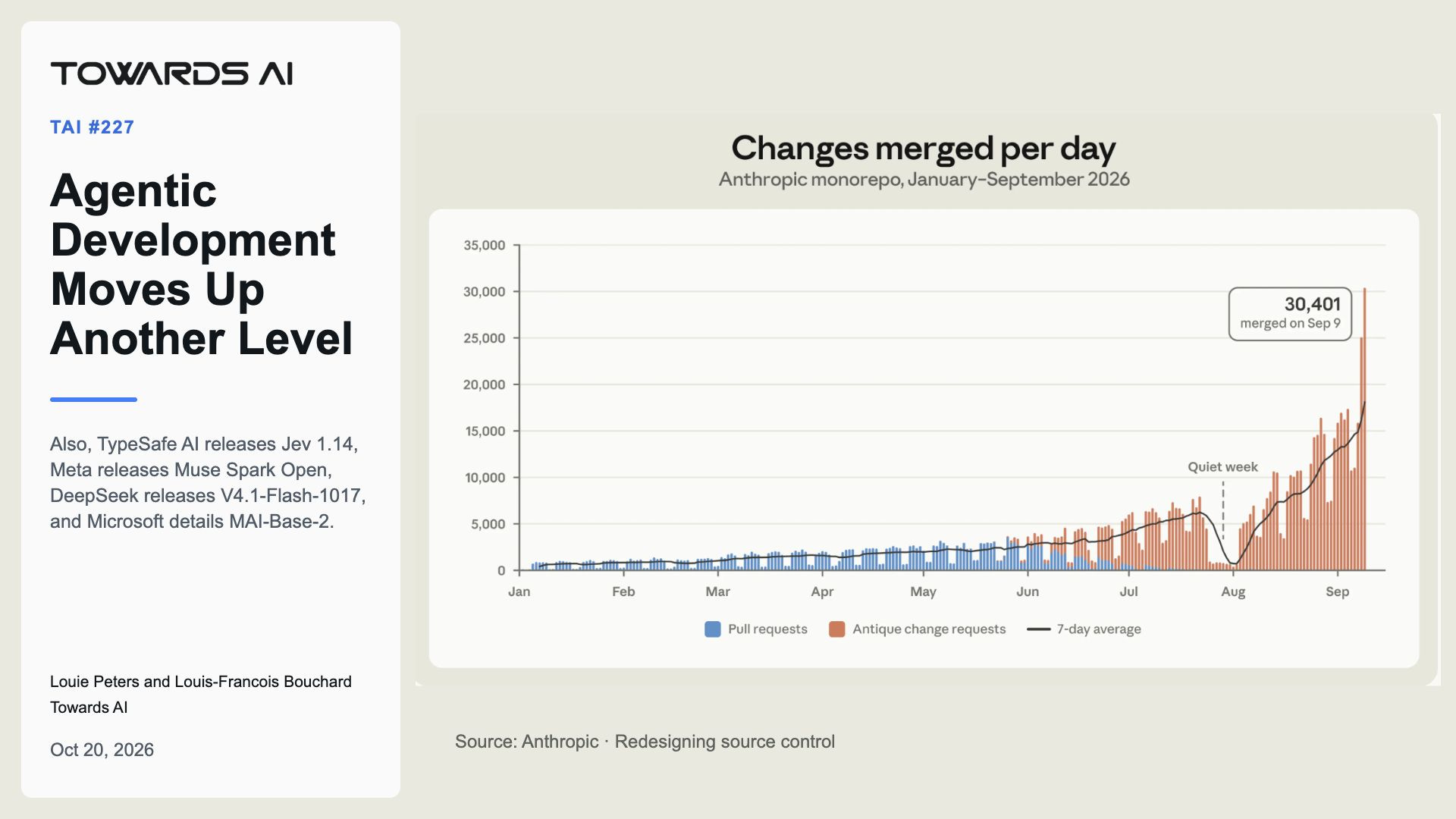
Changes merged into its monorepo rose from roughly 2,500 a day in May to more than 30,000 a day by September. An earlier series showed average daily lines merged per active contributor reaching 2.5x the pre-2025 average in Q4 2025, 5.8x in Q1 2026, and 8x in partial Q2 data. Taken together, the numbers suggest that code merged per engineer at Anthropic is now likely well over 20x higher than it was at the start of the year.
My impression is that most enterprises are still closer to where Anthropic was in late 2025, when output per engineer was around 2.5x its earlier level. The jump that followed came after better model intelligence and memory compaction made it practical to hand agents much larger coding tasks. Getting even that much from the models requires developers to change their day-to-day role entirely. They write less of the implementation themselves and spend more time scoping tasks, directing agents, checking results, and correcting mistakes. I think very few enterprises have fully adopted Mythos- or Astra-class workflows. Anthropic’s own move to Mythos in the first half of this year pushed its workflow much further again; Astra is a more recent example of the same capability class.
I use four rough levels to separate these workflows. One team can sit at different levels on different projects.
Levels 0.5 to 0.9 cover the progression from GitHub Copilot a few years ago through to Cursor-style editor workflows last year. AI fills in more of the implementation, and the developer still decides every next step. These are descriptions of workflows; the product name alone does not tell us the level.
Level 1 is what faster-moving enterprises do today, broadly unlocked in December 2025. The developer hands substantial implementation to an agent that reads the repository, edits files, and runs tests, then directs it frequently and decides when to move on. Much of our own team works at Level 1.
Level 2 is post-Mythos agentic coding as Anthropic practices it, with longer-horizon tasks, more subagents, and agents running their own research, implementation, criticism, and testing loops. Here, much more developer work moves to scoping and review/feedback, with the agent completing much more in one go in between.
Level 3 is the stage Anthropic’s move beyond Git shows: review, integration, and infrastructure need to be redesigned around the volume of work agents produce.
Moving from Level 1 to Level 2 requires a second role change. The developer has to give agents more autonomy and find ways to contribute expertise and taste without micromanaging. That knowledge has to enter through the brief, the architectural constraints, the examples, and the acceptance checks. The hard part is deciding which human interventions improve the work and which just force it to move at human speed. Without good constraints, more freedom gives the agent more room to misunderstand what we wanted.
Anthropic’s move toward Level 3 began when the volume of agent-produced changes exceeded the assumptions built into tools designed for human-paced development. Seven engineers built Scion, the Antique review tool and related systems, and migrated Anthropic’s monorepo from Git in five months. Scion moves most operations onto servers and fetches files as clients need them. The Scion team still reviews the intent of every change and steps in when agents break system constraints or overcomplicate a design, leaving much of the line-by-line reading to agents. Git remains the right choice for almost every team; Anthropic describes an exceptional workload and an internal token budget few companies can match. For our own work, I would check where changes wait before buying more capacity to generate them.
Anthropic is also making more of this review workflow available outside its own teams. Claude Code Review became generally available for Team and Enterprise plans on October 15, with Quick, Standard, and Deep review levels. Anthropic says most reviews take six to ten minutes. The product posts findings on a pull request; approving or blocking the merge still follows your rules.
Internally, the Claude Code team works in a repository separate from the monorepo, gives agents runnable checks, and has a fresh-context subagent review each change. For trusted authors, human approval ranges from zero to two reviewers depending on risk, while sensitive changes keep their existing gates. From June to September, merged pull requests more than doubled, while the share that were later reverted fell by more than 40% in relative terms.
One pull request went through more than fifty rounds of review and fixes overnight before the team intervened; authors are now asked to reconsider the approach after three rounds. An obedient agent will turn an irrelevant review comment into another change, another review and another bill. Teaching agents which concerns deserve a fix, and when a fix would make the system worse, is part of moving up a level.
Agent management and related coordination rose from 10% of the average employee’s interactive Claude sessions in fall 2025 to 22% in spring 2026, while headcount tripled over the past year.
In an August survey of 1,334 staff, the median estimate was that AI already does 51% of the work of building an early-2026 frontier model, rising to 80% by the end of 2027 and 95% by the end of 2030. On average, staff expected AI to be technically able to do 75% of their own current work hours by 2030.
Longer tasks, parallel attempts, and independent reviews all burn tokens, and the return on that spend looks very different for Anthropic’s own engineers than for an enterprise paying metered rates. My rough estimate is that small teams on heavily used Team subscription plans get a 20–30x effective cost advantage over larger organizations that have to use enterprise terms at API rates. Plan limits and enterprise contracts vary; Claude Team, for example, supports up to 150 seats and allows $100 plans.
The labs will keep pointing their training at longer-horizon work, because agents that sustain research and engineering for days help build the next models, and that is their path to recursive self-improvement. If we stay at Level 1, we leave most of each new generation’s capability unused. However, the higher levels also blur the line with vibe coding, since we will accept more implementation that no human has read in full. The line I want to hold is between delegating the implementation and giving up the ability to judge it. We need to keep the expertise to challenge an architecture, assess a result, and know what the checks miss, while dropping the micromanagement that stops agents from doing substantial work.
Why should you care?
We need to decide which kind of agentic coding we want our own team to practice, and be clear about where each developer is today. Most of us are at Level 1. Moving up needs more tokens. Fortunately, small teams like ours can experiment with inference volumes that would be expensive on enterprise contracts. I would spend part of that advantage learning to commission much more ambitious work: a complete feature with tests, competing designs judged against the same requirements, or a difficult migration with a realistic failure and recovery plan. The goal is to find which extra agent work reduces human effort or improves the result. A large token count is a poor achievement on its own, and a long run that returns the wrong thing is an expensive way to postpone a decision.
The higher levels of agentic development blur the boundary with vibe coding. The developer writes less, reads less, and accepts more implementation that no human has read line by line. Some habits that made us careful engineers now cap how much work we can delegate, while others become more valuable as the volume of changes grows. Telling them apart takes judgment, and counting the lines a human inspected is a poor way to settle it.
One other update from us this week: Cloudflare has named Towards AI as Cloudflare’s leading European deployment partner for Cloudflare OS, its AI workspace for building and running agents that can securely connect to the tools and systems companies already use. The partner program aims to help enterprises move from experimenting with AI to adopting it across their teams, including training employees and turning existing workflows into useful agents within Cloudflare OS. This is closely aligned with the enterprise work we have been building at Towards AI, and we are excited to be part of the rollout.
Read Cloudflare’s full announcement to learn more about its approach to enterprise AI adoption.
— Louie Peters — Towards AI Co-founder and CEO
This issue is brought to you thanks to MongoDB:

Orchestration changes fastest, since capability keeps moving into models and shared protocols like MCP. Frameworks define contracts, while platforms operate the durable substrate beneath them: retrieval and memory, observability, durable state, and governance. Inside, you’ll find five production tests covering decision trace, recovery, freshness, control, and cost, plus a recommendation to keep frameworks swappable and place long-term commitment in the substrate.
Build AI you can trust and scale. Move past the promise with a unified platform for agentic AI, semantic search, and RAG, with text and vector search, embedding models, and real-time operational queries in one place.
Hottest News
1. Meta Launches Muse Wonder and Muse Wonder Full
Meta Superintelligence Labs released Muse Wonder and Muse Wonder Full, its most capable models to date, built for personal and professional agentic tasks. Both were trained at Meta’s gigawatt-scale Prometheus data center and build on larger, stronger base models than Muse Spark 1.3. Meta highlights two capabilities: Active Memory carries relevant context across conversations, while Active Focus keeps working toward a goal by trying alternative approaches, recovering from errors, and checking in before important actions. Meta reports state-of-the-art results across agent, memory, and coding benchmarks, and says Muse Wonder Full performs better on unfamiliar tasks than Muse Spark 1.3’s scaling trend would predict. Meta describes Muse Wonder as its most aligned model to date, with its strongest safeguards against CBRN and cyber misuse. Muse Wonder is available through the Meta Model API and Muse Code, while Muse Wonder Full is available to Muse Code subscribers. Muse Wonder will also power Muse, rolling out to subscribers first.
2. TypeSafe AI Releases Jev 1.14
TypeSafe AI released jev-1.14.0, an update to its Jev System One model with small improvements across the board and the largest expected gains in multilingual support. TypeSafe also introduced experimental “danger zone” features that developers enable through API headers. These include image input, which jev-1.13.0 already supported, a new box type that returns a single bounding box and is available only on 1.14, and access to longer contexts than TypeSafe normally enables in production. The company warns that these features remain too unreliable for production use. The new model is available as jev-preview, with jev-latest scheduled to switch to 1.14 one week after release. TypeSafe says it intends to give 60 days’ notice before formally deprecating 1.13, rather than before retiring it outright. A separate opt-in lets users share queries for debugging, while TypeSafe says it still won’t use those queries for training.
3. Meta Releases Muse Spark Open
Meta released the weights for Muse Spark Open, which it calls the most capable US open-weight model to date. The natively multimodal MoE model has 816B total parameters, 42B active parameters, and a 1M-token context window, and supports text, images, audio, and video as input. Meta says it is the first model in its class that can run on a desktop, using two Apple M5 Ultra Mac Studios with MLX. The release includes custom Helion GPU kernels in SGLang that Meta reports deliver 1.03–3.95× kernel-level speedups on NVIDIA and AMD GPUs. Weights are available through Hugging Face, Amazon SageMaker AI, Google Cloud Model Garden, and Microsoft Foundry, with hosted access from several inference providers. Meta says Muse Spark Open received additional safety post-training for the open-weight release and met its safety criteria, including preparedness evaluations conducted under the Meta Superintelligence Scaling Framework.
4. DeepSeek Releases V4.1-Flash-1017
DeepSeek released V4.1-Flash-1017, a minor update to V4.1 Flash with improvements across reasoning, coding, agentic tasks, and vision. In DeepSeek’s evaluations, Terminal-Bench 4.0 rose from 31.2% to 42.3%, ProgramBench from 20.3% to 29.1%, Automation-Bench from 54.8% to 60.5%, and DeepSWE v1.1 from 74.2% to 77.0%. DeepSeek says the update also reduces task completion time and output length, and uses reinforcement learning with self-feedback to improve end-to-end project development, including coding and 3D-modeling tasks. The open weights are available under the MIT License, with a recommended 1M-token context window and support for text and interleaved images.
5. Microsoft Details MAI-Base-2
Microsoft AI announced that it had completed pre-training MAI-Base-2, an MoE foundation model with 2.8T total parameters and 80B active parameters. Microsoft reports that it outperformed every open-weight model it tested on its held-out evaluations and estimates that its training recipe is 4–12x more FLOPs-efficient than DeepSeek-V4-Pro-Base across four held-out evaluations. The model was trained on 16,000 GB200 GPUs for 38 days in August and September using a 50T-token training mixture, and is natively multimodal through an encoder-free vision architecture. Microsoft says its pre-training uses organic data rather than distillation from other models and that this provenance will allow it to license weights to trusted partners through Foundry. Technical changes include MoE layers throughout the model, the Muon optimizer, and activation gradient clipping for training stability. MAI-Base-2 is now undergoing post-training, while preparations for MAI-Base-3 are already underway.
6. NVIDIA Releases Nemotron 3.5 Super VL
NVIDIA released Nemotron 3.5 Super VL, an open multimodal model with 120B total parameters, 12B active parameters, and up to a 1M-token context window. Its hybrid architecture combines Mamba-2, Transformer attention, MoE layers, and a C-RADIO vision encoder for text, images, documents, and video. NVIDIA reports up to 5× higher single-GPU throughput than other open models in its size category. It reports scores of 63.44% vs. 56.33% for Nemotron 3 Ultra on Hermes Bench, 87.05% vs. 84.3% on LangChain evaluations, and 80.8% on CharXiv reasoning. NVIDIA released base, post-trained, and NVFP4 checkpoints alongside training recipes, datasets, and reinforcement-learning resources; it also released an Indic pre-training dataset containing about 2.8T tokens across 22 Indian languages, although only 10B Indic tokens were added during this model’s continued-pretraining stage.
7. Claude Solves the 25-Year Mystery of NIST’s Elliptic-Curve Seeds
Anthropic announced that an internal Claude research model traced the origins of most of the unexplained seeds behind NIST’s widely used elliptic curves, whose provenance had been questioned since the curves were standardized in 2000. In under half an hour, Claude found that the seeds for P-192, P-224, P-256, P-384, and P-521 came from the C library’s lrand48 pseudorandom-number generator initialized with Unix timestamps between May 1997 and April 1998, rather than from hashes of a phrase as previously rumored. It also explained four of the five binary-curve seeds and the base points for six curves. Anthropic stresses that the finding is not a cryptographic break and says the simple, reproducible generation process makes deliberate backdoors considerably less plausible. The B-163 seed and several base points remain unexplained. Anthropic published reproduction code, and the $36,864 bounty for solving the seed mystery will be donated to the Internet Security Research Group.
8. SpaceXAI Releases Grok Voice 3.0
SpaceXAI released Grok Voice 3.0, calling it its most capable speech-to-speech model. In Artificial Analysis’s independent testing, it ranks first on the Speech-to-Speech Index at 86.9, ahead of GPT-Live-1 at 83.2 and Gemini 3.8 Live at 82.6, and scores 97% on Full Duplex Bench for conversational dynamics such as pauses, turn-taking, and interruptions. On τ-Voice, which tests support calls with accents, noise, and interruptions, it scores 71.6%; SpaceXAI notes that this is comparable to GPT-Live-1 while using 40% lower latency. SpaceXAI reports overall response latency below one second, while Artificial Analysis measured a lower cost per Big Bench Audio task than GPT-Live-1 and GPT-Realtime-2.1. The company says Grok Voice handles millions of conversations per day in Tesla vehicles and about 20,000 Starlink support calls daily, with roughly 70% resolved without human intervention. Grok Voice 3.0 is available through the Voice Agent API at $0.08 per minute, unchanged from Grok Voice 2.0.
AI Tip of the Day
When developers first give an agent search access, relevance is often the main filter: find pages related to the query, then let the model read them.
That becomes expensive as the system scales. More searches bring in more pages, and relevant pages often overlap. You waste context, add latency, and spend money processing the same information multiple times.
We ran into this while scaling Nova, the research agent we built in Agent Engineering. Its searches kept surfacing shady blogs, sales pitches, low-quality pages, and several sources making essentially the same point.
So we stopped ranking sources on relevance alone. Nova now checks three things:
Trust: is the source reliable enough to use?
Relevance: does it answer the research question?
Novelty: does it add information the agent does not already have?
Sources that pass the first filters stay in the research file as short summaries. Nova then chooses only five to read in full, partly based on whether they add something missing from the material already collected.
If your agent already ranks search results by relevance, add novelty before loading the full page. Compare each source with what the agent already has. If it mostly repeats the same information, keep the summary or skip it.
Five 5-minute reads/videos to keep you learning
1. Build a Jev-Style Decision Model from an LLM
LLMs generate text one token at a time, so even a ten-token JSON routing answer costs ten sequential passes. This article shows how to turn a standard model running on TensorRT Edge-LLM into a one-pass decision model by applying a +100 logit bias to the allowed label tokens and renormalizing their returned probabilities, without additional training. It compares this approach with normal structured generation, which ran 4.54× slower.
2. How I Fine-Tuned Laya to Solve an Important Problem in Scientometrics — With Claude Code
This article follows an example of institution name disambiguation that maps messy affiliation text to the correct institution despite abbreviations, spelling differences, and similar names, but reframes the task as a pairwise yes/no decision. It fine-tunes Laya on 17,500 labeled pairs from 163 countries using free Kaggle GPUs. The resulting model reached 99.2% test accuracy and outperformed string similarity, sentence embeddings, a production registry API, and GPT-4o-mini.
3. Are LLMs Enough? What Causal Intelligence Is Trying to Fix
This interview explores how causal world models try to learn the effects of interventions and how tests such as CD-LAM’s zero-action experiment check whether a model learned a causal relationship or a shortcut. It also covers CausalWM v1’s progression from motion and geometry to video prediction, its current failure modes, and the lack of closed-loop robot evidence so far.
4. Azure Document Intelligence or Content Understanding? Route by Document Type
Azure Document Intelligence and Content Understanding share the same OCR and layout foundation, but they use different approaches to extract fields from documents. This article maps stable, labelable forms to purpose-trained models and more varied layouts, classification tasks, and reasoning-heavy extraction to generative analyzers. It also compares container support, API versions, per-page costs, and preview limitations. A semantic evaluation harness then shows how to score extraction quality by business value rather than exact string matches.
5. Run MCP Servers Through Docker With Secrets in the Keychain
Docker’s MCP Toolkit documentation does not cover how to run a custom Postgres server while keeping the database password out of configuration files. This article sets up a Docker MCP Gateway profile for Claude Code, adds DBHub through a custom catalog entry with a passwordless DSN, and stores the credentials in the macOS Keychain with the docker mcp secret set. It also covers the typing and path errors that can break the setup and how to fix them.
Repositories & Tools
1. Orca is an agent development environment for running Claude Code, Codex, and other CLI coding agents in parallel, each in its own git worktree, across desktop, mobile, and remote machines.
2. Ruflo is an agent meta-harness for Claude Code and Codex that adds coordinated agent swarms, persistent memory, and cross-machine agent federation.
3. Harness 2 is a framework for recursively refining agent harnesses on unseen tasks without changing model weights.
4. SPACE is a platform for running agent and user code in isolated Firecracker microVM sandboxes through an HTTP API.
5. Run:ai is an AI workload and GPU orchestration platform for managing shared AI infrastructure on Kubernetes.
Top Papers of The Week
1. Jeva: System One Models from First Principles
Fast decision-making models usually predict an answer from text, which ignores the structure of a decision problem. The authors argue that such models should recognize when no answer applies, give the same result regardless of option order, handle growing option sets, and reuse computation for options that recur across requests. Jeva is an architecture built around these four requirements, encoding the request and each option separately and scoring options with a shared mechanism. It combines strong decision accuracy with near-perfect detection of cases where no option fits, produces no decision changes when options are reordered, scales to thousands of candidates, and cuts latency by reusing option representations across requests.
2. Thinking Inertia: LLMs Keep Thinking When Told Not To
This paper studies LLMs’ no-thinking behavior along two axes: how to measure no-thinking, and how no-thinking varies across tasks and models. It normalizes each response into a pre-answer trace and final answer, and evaluates it at three levels: (i) Empty-Thinking Rate for strict answer-only compliance; (ii) instruction-aware Question-Pre-answer Relevance for similarity between the question and pre-answer trace; and (iii) LLM-as-judge Explicit Inference Rate for visible explicit inference. These metrics distinguish answer-only output, relevant but non-inferential text, and explicit inference.
3. MAI-Gym: Synthesized, Verifiable GUI Environments at 20,000-Way Scale
MAI-Gym is an open platform that combines GUI agent evaluation, data collection, and online RL training across mobile, computer, and web environments. It supports ten existing benchmarks and scales to 20,000 parallel environments. It can also automatically generate mock apps and multi-app worlds with tasks whose outcomes are checked by execution. The resulting 9B agent, MAI-Gym-9B, scores 78.4% on MobileWorld and 76.2% on OSWorld-Verified, the best among open GUI agents under 10B parameters.
4. OpenGCUA: A Fully Open Stack for Generalist Computer Use
Computer-use agents are moving towards systems that complete tasks on users’ computers through visual and programmatic interfaces, but leading implementations like GPT-6 Astra remain closed. OpenGCUA is an ongoing open project to build this full stack, with this report as its first release. Its agent design leans on code execution so that intermediate results can shape later steps, and it shifts some decisions from fixed harness rules to the model itself. On OSWorld-v2, the full setup improves scores for all eight tested models, including GPT-6 Astra and Claude Opus 5, raising the mean partial score by 19.6 points and cutting steps per task by 53% on average compared with GUI-only execution.
Quick Links
1. Mistral AI releases Timestral, its first family of time-series foundation models, available in four sizes (5M, 28M, 123M, and 209M parameters). The models produce probabilistic, multivariate forecasts and can factor in both past and known-future inputs, such as production schedules or weather forecasts, without needing to be trained on each new dataset. Mistral reports that the 209M model ranks first among pretrained, zero-shot models on GIFT-Eval, TIME, and fev-bench, beating the previous state of the art with two-thirds of its parameters. Code is on GitHub and weights are on Hugging Face under a modified MIT license, with fine-tuning available through Mistral Forge.
Who’s Hiring in AI
Forward Deployed Engineer — AI @IBM (Remote/USA)
AI Growth Ops @Kraken (Remote)
Forward Deployed Solution Engineer @ServiceNow, Inc. (London, UK)
Python/GenAI Developer @CAI (Remote)
Forward Deployed Engineer @Onebrief (Remote/USA)
AI Research Scientist, Agentic Systems @CrowdStrike (Remote)
Interested in sharing a job opportunity here? Contact sponsors@towardsai.net.
Think a friend would enjoy this too? Share the newsletter and let them join the conversation.